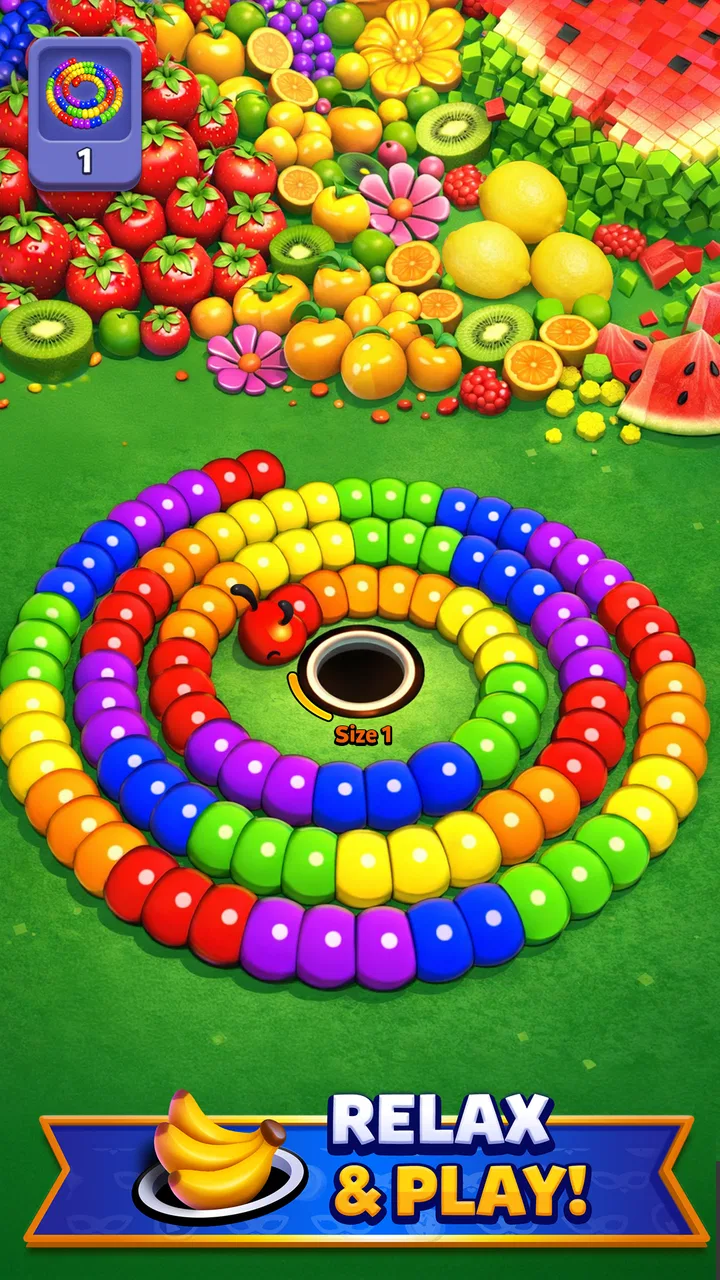
All in Hole: Black Hole Games
- 4.8
- Rating
- 10.00M
- Installs
- Free
- Price

 Analysis by App-foxy
I picked up All in Hole: Black Hole Games expecting a simple time-killer, and that is exactly where it fits best: short puzzle sessions built around guiding a growing black hole through objects and spaces. The idea is immediately understandable, but the appeal comes from the combination of movement, timing, and the satisfying feeling of clearing a crowded area. I can see why it works well on a shared phone or tablet, especially when different people want something they can understand without a long tutorial.
This is a free puzzle game from Homa, rated for Everyone. It has reached more than five million installs and holds an average rating of 4.9 from roughly 152 thousand ratings, which suggests that its basic loop connects with a large audience. I would still treat those figures as a sign of broad appeal rather than a guarantee that every player will enjoy it. The game is deliberately casual, and that focus makes it accessible, but it also means players looking for deep strategy or a long-form adventure may find it lightweight.
How the black-hole puzzle loop works in everyday play
The central action is easy to grasp: move the hole around, swallow suitable objects, become larger, and use that growth to handle more of the environment. It is a clean progression from small targets to bigger opportunities. I like that the game does not ask me to memorize complicated rules before I can enjoy it. The visual result of objects disappearing into the hole gives each move an immediate payoff, which is especially effective during a quick break.
You May Also Like

 Blood Strike: 2.5 Anniversary
Blood Strike’s Loadouts Turn Every Drop Into a Tactical Gamble
A close look at Blood Strike’s custom loadouts: how fast access to signature weapons reshapes its battle royale rhythm, rewards preparation, and narrows the gap between fights.

 Pandora - Music & Podcasts
Pandora’s Music Is Easy to Start, but Harder to Recover
Pandora’s strength is its low-effort path from a seed to a station. Its weak spot is how much confidence it asks you to place in connection, setup, and quiet recovery.

 8 Ball Pool
 Is Built on Rivalries, Rematches, and Routine
A close look at the rivalries, rematches, shared routines, and unanswered safety questions that turn a quick pool match into a persistent mobile community.

 Samsung Music
’s Quiet Strength Is Playing What You Already Own
Its reach comes less from spectacle than from dependable access to a personal library. That simplicity is both the app’s strongest retention engine and its ceiling.

 AccuWeather: Weather Radar
AccuWeather Review: A Quick, Clear Forecast for Everyday Decisions
For everyday plans, the best forecast is the one you can understand quickly. AccuWeather makes rain timing, radar, and local conditions easy to act on, with a few trade-offs.

 Hill Climb Racing
Why Hill Climb Racing Still Turns Crashes Into One More Run
A tiny car, a bumpy hill and one more upgrade: Hill Climb Racing keeps resurfacing because its simple chaos makes every near-miss feel personal.
More From Our News Desk



In my experience, the best sessions are the ones where I stop treating the hole as something to steer randomly and start planning a route. Early objects are not merely targets; they help create the size needed for later ones. That makes the puzzle layer more interesting than simple tapping. A useful habit is to scan the whole area before moving, identify the easiest objects first, and avoid rushing toward the most tempting large item if it is not yet reachable.
That small change in approach is one of the game’s less obvious strengths. Someone playing casually can simply move and collect, while a more deliberate player can think about order, positioning, and wasted movement. The same level can therefore feel relaxing on one attempt and mildly tactical on another. It is not a demanding strategy game, but it gives the basic mechanic enough structure to reward attention.
The controls are naturally suited to touchscreens because the main task is direct movement. That makes the game easy to hand to another person without explaining a control scheme. On a shared device, I would expect the first few minutes to be enough for a new player to understand what to do. This is useful with mixed experience levels: a child, a parent, or a friend can try it without needing the same gaming background.
A practical shared-device session
Imagine a household waiting for dinner or taking a short break after school. One person can play a level, pass the phone over, and let someone else try the next one. The game’s premise is visible on screen, so the handoff does not require a lengthy explanation. That makes it more suitable for casual turn-taking than a puzzle game built around a large story, complicated inventory, or personal character development.
There is also room for friendly coordination. One player may notice the safest route while another controls the hole. A younger player can choose where to move, while an older player helps with planning without taking over completely. I would encourage that kind of cooperation rather than turning every session into a competition over speed. The game is at its most pleasant when the shared goal is figuring out how to clear the space efficiently.
Still, it is important to understand what the game is not. I would not choose it as a substitute for a dedicated multiplayer puzzle experience. Passing a device around is a social habit, not proof of a built-in shared mode. If your household wants simultaneous play, direct communication between accounts, or a long competitive ladder, a different category of game will be a better match.
Setting expectations before handing it to someone else
Because the game is free to download, it is easy to try without making a purchase decision first. That lowers the barrier for a shared device, but I would still establish a simple household rule before letting a child play: free to start does not automatically mean free of optional spending. The listed in-app purchase range runs from $0.99 to $99.99 per item, so purchase boundaries matter even when the game itself costs nothing to install.
I would also separate the idea of age suitability from spending permission. The Everyone rating indicates broad content suitability, but it does not decide whether a particular child should have unrestricted access to purchases or extended screen time. In a family setting, the adult should handle those decisions. The game can be appropriate to try together while still needing clear device-level purchase settings and an agreement about when the session ends.
Another useful boundary is ownership of progress. On a shared phone or tablet, I would avoid assuming that every person has a separate profile or independent save space. If several people use the same installation, decide whose progress is being advanced and whether passing the device back and forth is acceptable. This prevents a common household argument: one person believes they are helping, while another sees the same actions as changing their game.
That point is easy to overlook because the gameplay looks so simple. A short puzzle session can still involve progress, unlocks, or purchase decisions that someone else may not want touched. My practical advice is to agree on one primary player for the device, or to treat the game as a communal activity where everyone accepts that the same run belongs to the group.
Why the age rating helps, and where trust still matters
The Everyone content rating makes the game easier to consider for a broad household audience. Its central concept is playful rather than dependent on mature themes, and the puzzle format is approachable for people who are not regular gamers. That makes it a reasonable option when you want an uncomplicated activity that can be demonstrated quickly.
Even so, an age label should not replace supervision or conversation. Younger players may understand the black-hole mechanic immediately but not understand why an optional purchase appears, how progress is shared, or why a device needs to be returned. I would play the first session together, explain the household rules, and then decide whether independent play makes sense.
Trust also applies to the way people use the device. A game that is easy to pick up is easy to open repeatedly, so the real issue may be whether it fits the household’s routines. If the phone is needed for calls, schoolwork, navigation, or work messages, I would keep sessions short and make the handoff explicit. The game is good at filling spare moments, but that convenience can become distracting if nobody agrees when to stop.
How it compares with other puzzle choices
Compared with a traditional match-three puzzle, this game feels more physical. Instead of swapping pieces or looking for identical symbols, I am navigating a space and deciding which objects to consume first. That gives movement a larger role and makes the screen feel more like a small playground. Players who enjoy planning a route may prefer this style, while players who want a purely visual pattern challenge may find the steering less satisfying.
It also differs from physics puzzles that focus on building structures, cutting ropes, or manipulating fixed objects. Here, the hole itself is the main tool, and growth is the central reward. The simplicity makes it easier to share with a newcomer, but it may not offer the same kind of layered problem solving found in games where every object has several possible uses.
Against endless-runner games, the pace is less about surviving a constant stream of hazards and more about clearing a defined puzzle space. That makes it a better fit for someone who wants a moment of control rather than reflex pressure. On the other hand, if you prefer fast reactions, score chasing, or a strong sense of personal mastery, the calmer structure may feel repetitive after several sessions.
Its offline-friendly positioning is another practical advantage for travel or places with unreliable connectivity, but I would not build a whole device plan around that phrase alone. Some games behave differently when services, advertising, or purchases are involved. I would test the exact situations that matter to you before a flight or a long trip. The useful takeaway is that the core concept is well suited to short, low-commitment play, not that every surrounding function should be assumed to work identically without a connection.
Small strategies that make the game more enjoyable
My first tip is to use the edges of the play area deliberately. New players often chase the nearest object and then end up in an awkward position. A wider route can be better if it lets the hole collect several easy targets in sequence. This is not about moving slowly for its own sake; it is about turning the opening part of a level into preparation for the more demanding objects.
My second tip is to treat growth as a resource rather than a visual effect. Before attempting a larger target, ask whether there are smaller objects that can be collected with little detour. This reduces wasted movement and makes the later part of the puzzle feel more controlled. It also gives a child a simple planning lesson: do the manageable steps first, then return to the difficult goal.
My third tip is for shared play: let the person holding the device describe the intended route before moving. That creates coordination without requiring a formal multiplayer system. If another player sees a better option, they can explain why rather than grabbing the phone. In a family setting, this turns a solitary puzzle into a small communication exercise and avoids the frustration of several people giving conflicting directions at once.
A fourth trade-off is worth noting. The most satisfying moments come from clearing objects efficiently, but trying to optimize every move can remove the relaxing quality that makes the game attractive. I would use careful planning when a level feels tricky and switch to casual play when the goal is simply to unwind. The game supports both attitudes, but they produce very different experiences.
Performance, access, and purchase awareness
The current version is 7.1.4, and the listed minimum operating system is Android 7.0. That makes the compatibility range useful for people using an older Android device, although actual comfort will still depend on the phone or tablet’s condition, screen size, and available storage. A larger display can make shared play easier because two people can see the route, while a smaller phone is more convenient for private sessions.
The free entry point is a genuine benefit when deciding whether the mechanic suits your household. You can try the basic experience before committing money, which is especially helpful when different family members have different tastes. The caution is that optional purchases can change the way a child experiences the game, so I would keep spending controlled at the device or account level rather than relying only on verbal instructions.
I would also be careful about using the game as a reward system. Because the levels are short and the action is immediately understandable, it can be tempting to say “just one more.” That may be fine during a planned break, but it is less suitable immediately before bedtime or during homework. The game’s strength as a quick distraction is also the reason it needs a clear stopping point.
Who should install it, and who should look elsewhere
I recommend giving it a try if you want a cheerful puzzle game that explains itself quickly, works well in short bursts, and can be discussed while someone else plays. It is particularly suitable for households that enjoy passing one device around, comparing routes, or helping a less experienced player understand a level. The broad age rating and simple premise make the first contact easy.
I would be less enthusiastic for someone searching for a deep campaign, character-driven progression, complex logic puzzles, or a strong competitive community. The black-hole mechanic is the star, and the game’s value depends on how much enjoyment you get from repeating that style of movement and collection. If you need separate household accounts, carefully divided progress, or guaranteed simultaneous cooperation, check those needs against a more structured multiplayer or family-focused alternative.
It is also not my first choice for a player who dislikes games built around gradual growth. The loop depends on starting small and becoming capable of consuming larger objects. That progression is satisfying when it clicks, but anyone who wants every challenge to introduce a radically new rule may find the design too focused.
My household verdict
After spending time with it, I see All in Hole as a strong casual puzzle option rather than a game I would ask everyone to play for hours. Its best qualities are immediate understanding, tactile movement, and the small strategic decisions that appear once I plan the order of objects instead of simply chasing them. Those qualities make it unusually easy to share with a friend or family member for a few minutes.
The main responsibility falls outside the puzzle mechanic: decide who owns the progress, how the device is passed around, and whether purchases are allowed. The Everyone rating makes the content approachable, but household trust still depends on supervision, spending rules, and respect for the device’s other uses. Those boundaries are especially important when a child is playing independently.
Homa has made a game that is easy to recommend as a free trial, and the large audience reflected by its rating and install count supports that impression. I would install it for travel, waiting rooms, or a shared evening break, while keeping expectations realistic about depth and long-term variety. If you want a simple puzzle that turns movement and gradual growth into a satisfying shared activity, this is worth trying; if you need deep strategy or robust account separation, choose something more specialized.
FAQs for All in Hole: Black Hole Games
01What is the main objective of All in Hole: Black Hole Games?
All in Hole: Black Hole Games is designed to test your strategic skills by challenging you to control a black hole and absorb various objects. The main objective is to grow your black hole by consuming everything in sight while avoiding obstacles. It’s a captivating mix of strategy and reflexes that keeps players engaged.
02Is All in Hole: Black Hole Games suitable for all age groups?
Yes, All in Hole: Black Hole Games is suitable for players of all ages. Its intuitive controls and engaging gameplay make it accessible to children, while the strategic elements provide a fun challenge for adults. The game does not include any inappropriate content, making it a family-friendly choice.
03Does All in Hole: Black Hole Games require an internet connection?
All in Hole: Black Hole Games can be played offline, allowing users to enjoy the game without needing an internet connection. However, some features like leaderboards or in-game purchases may require connectivity. This offline capability makes it a great option for entertainment on the go.
04What platforms is All in Hole: Black Hole Games available on?
All in Hole: Black Hole Games is available for both Android and iOS devices. Players can download it from the Google Play Store and the Apple App Store. The game is optimized for mobile devices, offering smooth performance and intuitive touch controls on both platforms.
05Are there any in-game purchases in All in Hole: Black Hole Games?
Yes, All in Hole: Black Hole Games includes optional in-game purchases. Players can buy items to enhance their gameplay experience, such as skins or power-ups. While purchases can enhance the game, they are not necessary to enjoy or complete it, ensuring a balanced experience for all players.
Pros
- Engaging gameplay with diverse challenges.
- Intuitive controls for smooth navigation.
- Regular updates with new levels.
- Visually appealing graphics.
- Suitable for all age groups.
Cons
- Contains ads that can interrupt play.
- Requires internet connection for some features.
- In-app purchases for advanced levels.
- Battery consumption is relatively high.
- Limited offline functionality.

All in Hole: Black Hole Games
Gallery